Stamping options

Mounted stamps

Traditional red rubber stamps often come mounted (permanently adhered) to a wooden block.

Un-mounted stamps

To save cost and storage space, many new stamps come unmounted.  The red rubber or clear photopolymer stamp must be temporarily mounted in order to stamp.

Acrylic block

The lowest cost option is an acrylic block.  The block will easily pick up the clear photopolymer stamp or the gray cushion on a red rubber stamp.

Stamp Platforms

A stamp platform is an alternative to an acrylic or wooden block that allows repeat stamping in the exact same place.  Stamp platforms can be used with red rubber or clear photopolymer stamps.

Stampin Up Stamparatus $50

7” x 7” base, allows material larger than that to hang out on two sides, offers two reversible lids for layer stamping up to four images (discontinued in 2023, may find used)

Misti by My Sweet Petunia $70

6.5” x 8.5”, enclosed so material cannot hang out and must fit within size of device

Memory Misti is 12 x 12, $109

Sizzix Stencil and Stamp Tool $60

8.25” x 11.75”, open on three sides, offers a stencil holder (that gets bad reviews)

Tonic Tim Holtz Stamp Platform Discontinued in USA

Came in 8’ x 8” and 12” x 12”, open on two sides, for about $35.  Worth seeking out used or overseas.

Not quite the same:

Altenew stamp wheel – entire top layer comes off, no hinge, has the ability to turn to create a stamped wreath, integral sticky mat $100

Crafter’s Companion – it’s more like an acrylic block with springy legs, not a stamping platform

Fiskar’s Easy Stamp Press – another acrylic block on legs

Also check out localkingrubberstamp.com for Lisa’s tutorial (#45 in the video library) for making your own from a CD case, or follow the link to YouTube:

https://www.youtube.com/watch?v=9KHl54k4OxQ

Details on Adhesive

Details from my analysis of adhesive. All prices in US dollars, and your price may vary based on bulk buying, coupons, shipping, taxes, and so forth. You are paying for the dispenser and the less dispenser you pay for the less expensive the product.

LIQUID GLUE

Lawn Fawndamentals glue tube 11.00 per ounce 0.55 per foot

Gina K Connect 11.00 per ounce 0.55 per foot

Aleene’s Tacky Glue pen 9.40 per ounce 0.47 per foot

Nuvo Smooth Precision glue pen 8.01 per ounce 0.40 per foot

Elmer’s Precision glue pen 4.67 per ounce 0.23 per foot

Nuvo Deluxe Adhesive 4.99 per ounce 0.25 per foot

Ranger Glossy Accents 3.28 per ounce 0.16 per foot

Reptile Premium craft adhesive 2.70 per ounce 0.27 per foot

Reptile in needle nose 1 oz 0.14 per foot

Bearly Art Precision Craft Glue 1.64 per ounce 0.08 per foot

Elmer’s Glue All Extra Strong 0.31 per ounce 0.03 per foot

Elmer’s in needle nose 1 oz 0.02 per foot

Aleene’s Original Tacky Glue 0.31 per ounce 0.03 per foot

Aleene’s in needle nose 1 oz 0.02 per foot

Big bottle, regular tip repackaged into a one-ounce needle-nose bottle is the least costly.

TAPE RUNNERS

Scotch Extra Strength tape runner 0.33  per foot

Tombow Xtreme tape runner 0.28 per foot

Scotch Create tape runner 0.19 per foot

Elmer’s tape runner 0.19 per foot

Duck Easy Stick tape runner 0.19 per foot

3L E-Z strips tape runner 0.15 per foot

AdTech tape runner 0.12 per foot

American Crafts Sticky Thumb  0.11 per foot

Tombow Mono tape runner 0.11 per foot

Sookwang tear tape 0.08 per foot

ATG refill 0.08 per foot

Recollections tape runner 0.07 per foot

Scor-tape tear tape 0.06 per foot

Tear tape with no dispenser is the least costly.


Cost-efficient adhesive

I continued my review of all my adhesives and learned a few things:

  • Liquid glue is pretty much the same; I’m paying for the dispenser.
    • Glue pens are the most costly per ounce, and big bottles with big nozzles are the cheapest. No great surprise there, but the least expensive glue is an astonishing 1/36 the price based on a per-ounce calculation. Is Gina K Connect 36 times better than Aleene’s? No, no it is not. I put the cheap glue in a one-ounce needle nose bottle for the most bang for my adhesive buck.
    • After testing all 14 (!) kinds, I understand why Bearly Arts and Art Glitter are so popular since they run about $1.60 an ounce, but Elmer’s Glue All Extra Strong or Aleene’s Original Tacky Glue in a one-ounce needle nose bottle is 1/8 the price and just as good.
  • Tape runner is not inherently more expensive than glue. I calculated the price per foot for liquid glue and tape runners, thinking liquid glue would run away with this competition… but it didn’t.
    • Tape runners also increase in price based on the dispenser. Disposables cost the most, refillables cost less, and no-dispenser tear tape costs the least.
    • The price per foot for tear tape, ATG refills, and no-name tape runners is around $0.06 – $0.08 while Elmer’s/Aleene’s/Bearly Arts/Art Glitter runs $0.02 – $0.08.
  • I need to stop buying adhesive because I have a lifetime supply.

Ink pads

There are five types of ink pads:

  • Dye ink
  • Pigment ink
  • Hybrid (dye/pigment) ink
  • Alcohol ink
  • Embossing ink

Prices generally start around $7 per ink pad for a “full size” pad which is generally 2” x 3”.  Mini ink pads cost about half and are generally 1” x 1”, but contain roughly 20% as much ink as a full size ink pad.  Ink pads can be made of a felt pad with linen cover or made of foam.

Dye ink pads are quick-drying.  They can be either water-reactive or non-water-reactive.  One common type of traditional, non-water-reactive dye ink pad is Stampin Up.  The most common type of water-reactive dye ink is Ranger Distress by Tim Holtz.  There are many brands of both types, including Simon Says Stamp, Hero Arts, and Altenew.  

Most stamping is done with dye ink, whether water-reactive or not.  Dye ink should be used for stamping an image to be colored with alcohol ink markers (e.g. Copic).  

Pigment ink pads are slow-drying.  Brands include Versafine (by Tsukineko) and Ranger Archival.

Hybrid ink pads have elements of both dye and pigment.  They can be water-reactive (like Ranger Distress Oxide by Tim Holtz) or non-water-reactive.  There are many brands, although most are non-water-reactive.

Alcohol ink pads are used for non-porous surfaces such as tile or plastic.   The most common brand is Staz-On.

Embossing ink is a clear, sticky ink used for tone-on-tone stamping or embossing.  The most common brand is Versamark.

Pigment, hybrid, alcohol, or embossing ink should be used for stamping an image to be colored with a water medium (e.g. watercolor paint.)  Any sticky, slow-drying ink can be used for embossing, including pigment, hybrid, and embossing ink.

Manual die cut machines – basics and optional extras

Manual die cut machines are human-powered and offer a platform with rollers.  You crank a “sandwich” of cutting plate, die, and paper (or other material to be cut) through the rollers with a handle.

Basic pieces

  • machine
  • two cutting plates
  • multipurpose platform or adapter
  • die (shape cutter)

The standard cutting plates are a hard polycarbonate plastic.  They are consumable, so they will need to be replaced periodically.  Turn the plates over top to bottom, left to right, with every cut to reduce warping.  

The multipurpose platform or adapter raises the cutting plates so you can use thin dies instead of steel rule dies.  

You can successfully die cut with the basic pieces.  

Optional extras

  • self-healing cutting plate
  • extended cutting plates
  • chrome precision base plate
  • metal shim
  • magnetic plate
  • silicone pad / impression pad pair
  • die brush 

The standard cutting plates can be swapped for a self-healing plate on the cutting surface.  These are available from scrapbook.com or iCrafter or you can cut your own from any self-healing mat.  

Extended cutting plates are needed IF you have an extra-long die.

The chrome precision plate and metal shim may be useful for cutting detailed thin dies.  You can also add paper or cardstock shims to your sandwich.

A magnetic plate will gently hold thin steel dies in place.  You can also use low-tack tape.

The floppy silicone pad and softer (than polycarbonate) impression pad are used together to emboss (rather than cut) from a thin steel die.

A die brush or die pick can be used to eject small pieces of paper from cutting dies.

Dies and Embossing Folders

  • steel rule dies
  • thin steel dies
  • embossing folders

Steel rule dies are thick and heavy, 4 ounces or more, and cat cut chipboard, cardboard, or multiple layers of cardstock.  New dies are quite expensive, generally $40 and up, and the only company still making these is Sizzix.  

Thin steel dies are very thin, comparable to a few sheets of cardstock.  Generally these should be used to cut a single layer of cardstock. These are widely available from many manufacturers and designers at a wide range of prices.  Some thin dies are words or basic shapes, while others are made to cut out a co-ordinating stamped image.

Embossing folders are two pieces of plastic, hinged, that have a positive raised image on one side and a negative debossed image on the other.  You put a piece of paper between the two and run it through the die cut machine to emboss the image onto the paper.  These are also widely available and inexpensive.

Die cutting – what to look for at the thrift shop or garage sales

Manual machines use human power to put cutting plates or platform through rollers to apply steel dies to material such as paper, fabric, plastic, thin cork or leather.  Dies cost extra, but are widely available from a range of manufacturers.  

The originals, Sizzix and Spellbinders, can handle old-school steel rule dies that are about an inch thick, although only Sizzix continues to manufacture these at all.  The Sizzix Pro can handle Ellison dies commonly found in schools.  All of the machines in this category can handle thin steel dies.  Spellbinders also offers a compatible foil machine.  

The 6” opening will handle most dies.  

The best machine is the one you already own or can find used for cheap, but if I were buying new I’d pick Spellbinders (either version) and haunt their website (spellbinderspaperarts.com) and scrapbook.com watching for sales.  Sizzix is the one you are most likely to find used.

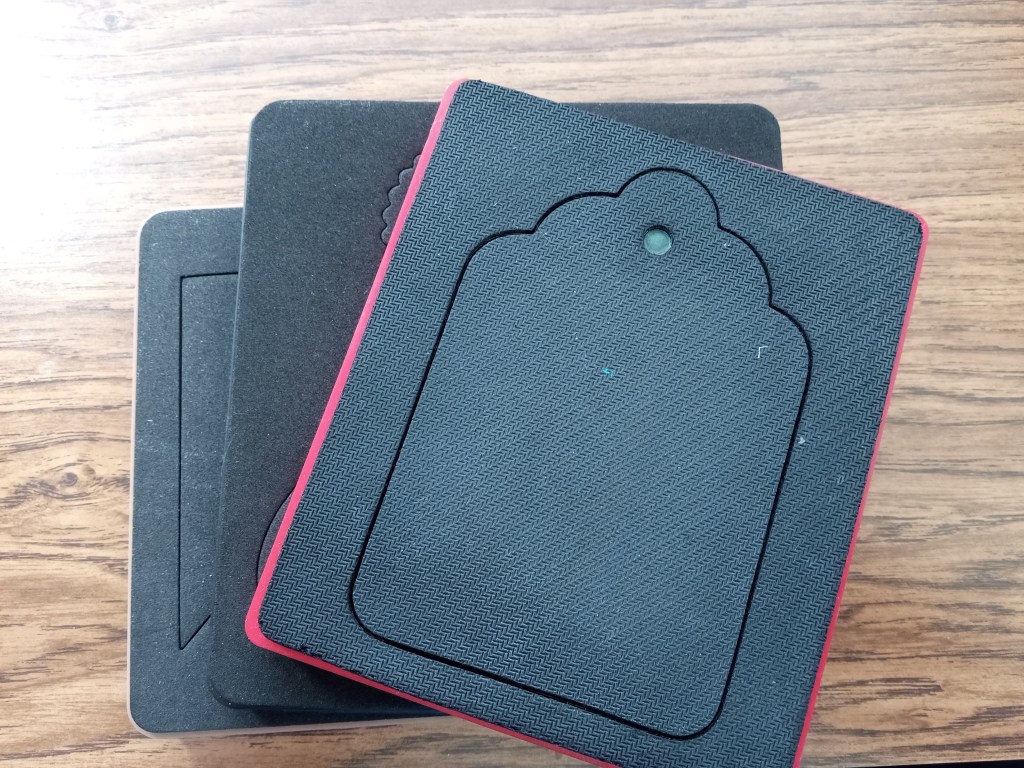
For a Sizzix Big Shot or Big Kick, if the handle turns then it works. In addition to the machine itself, you will need a pair of cutting plates (for thick steel rule dies) or a pair of cutting plates and a multipurpose platform (for thin steel dies) and a die. This is the Sizzix machine with a platform and one cutting plate. While the plate in the photo happens to be blue they most commonly come in clear:

The multipurpose platform should last the life of the machine, but the cutting plates do need to be replaced periodically.

Various colors and accessory packages are available, but these are the basic choices:

  • Sizzix
    • Big Shot – 6” opening, retail $139
    • Big Shot Foldaway – 6” opening, retail $229
    • Sidekick – 2.5” opening, retail $65
    • Big Shot Pro – 12” opening, retail $400
    • Spellbinder’s
      • Platinum 6 – 6” opening, retail original version $120 or improved version $200
      • Spellbinder’s foil machine available
    • We R Makers
      • Revolution – 6” opening, retail $150
      • Evolution Mini – 3” opening, retail $66
    • Heffy Doodle
      • Mini – 3” opening, retail $49
    • Momenta
      • Freestyle – 6” opening, retail $100
    • Crafter’s Companion
      • Mini Manual – 3” opening, retail $50  (formerly Diamond Press)
    • Hero Arts
      • Compact Cutter – 3” opening, retail $50
    • Anna Griffin
      • Mini Manual – 3” opening, retail $60

Electric machines handle thin steel dies (all brands) or steel rule dies (Sizzix) and use electricity to move the plates through the rollers rather than human power.  Gemini is the original here, but Anna Griffin certainly has some fans.

  • Sizzix
    • Big Shot Switch – 6” opening, retail $329
    • Big Shot Switch Plus – 9” opening, retail $400
  • Crafter’s Companion
    • Gemini Jr – 6” opening, retail $230
    • Gemini – 9” opening, retail $300
    • Gemini Go – 3” opening, retail $160
    • Gemini foil machine available
  • Anna Griffin
    • Empress – 6” opening, retail $270
    • Empress Mini – 4” opening, retail $180

Electronic machines use digital files and software to cut shapes.  Some machines can draw.  The Brother Scan and Cut can scan a stamped or printed image and cut it out, much like a matching steel die would.  

Cricut Maker 12”, $249

Cricut Explore (next gen) 12”, $319

Cricut Joy 4.5” $179

Brother Scan and Cut not quite 12” $399

Silhouette Cameo (next gen) 12”  $339

Silhouette Curio 12” $249

I understand Circut now requires an always-on wifi connection and monthly subscription; as always, carefully research before shopping.

For thrift store and garage sale shopping I would look for

  • Sizzix manual for under $50, including multipurpose platform
  • Steel rule dies – crafters abandon these because they are heavy and large, but new dies are $40 and up and used ones are treasure! Steel rule dies will cut chipboard, cardboard, or multiple layers of cardstock.

Papercraft Glue

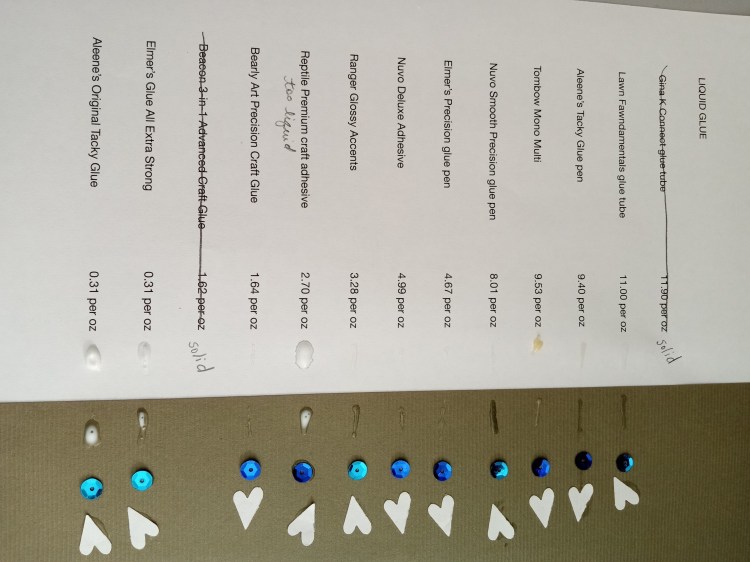
I compared the various glues I had in my craft room, inspired by Mary Palanco (https://youtu.be/DaaRhzmA0H4). Her test was great, but I was more interested in price per ounce than price per container.

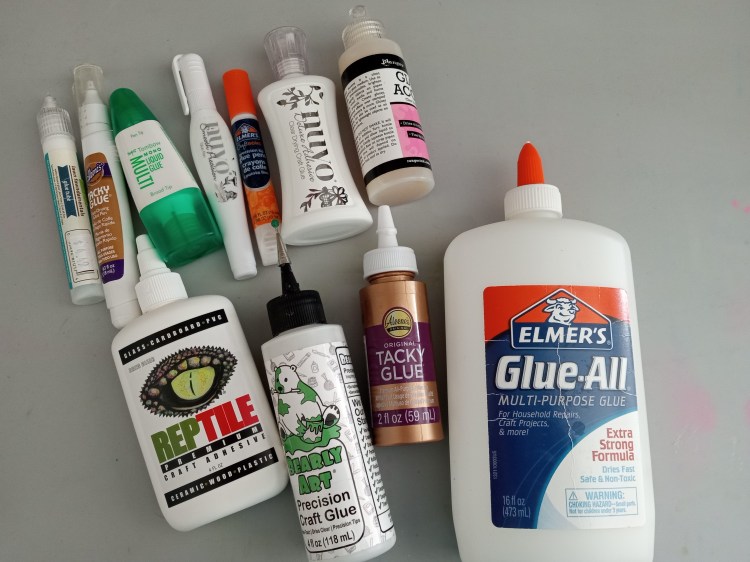
I tested 13 glues, all of them items I had and none bought for this purpose. The most expensive glues were glue pens or smaller bottles with fine tips, while the least expensive glues were large bottles with large tips.

I had to discard two glues that had solidified, probably from being stored unused but open for too long.

The expensive glue pens and slight less expensive fine tip bottles included:

  • Lawn Fawndamentals glue tube $11/ounce
  • Aleene’s Tacky Glue tube $9.40/ounce
  • Tombow Mono Multi $9.53/ounce
  • Nuvo Smooth Precision glue pen $8.01/ounce
  • Elmer’s Precision glue tube $4.67/ounce
  • Nuvo Deluxe Adhesive fine tip bottle $4.99/ounce
  • Ranger Glossy Accents fine tip bottle $3.28/ounce

The less expensive, larger tip bottles included:

  • Reptile Premium Craft adhesive $2.70/ounce
  • Bearly Art Precision craft glue with fine metal tip $1.64/ounce
  • Elmer’s Glue All extra strong $0.31/ounce
  • Aleene’s Original Tacky Glue $0.31/ounce

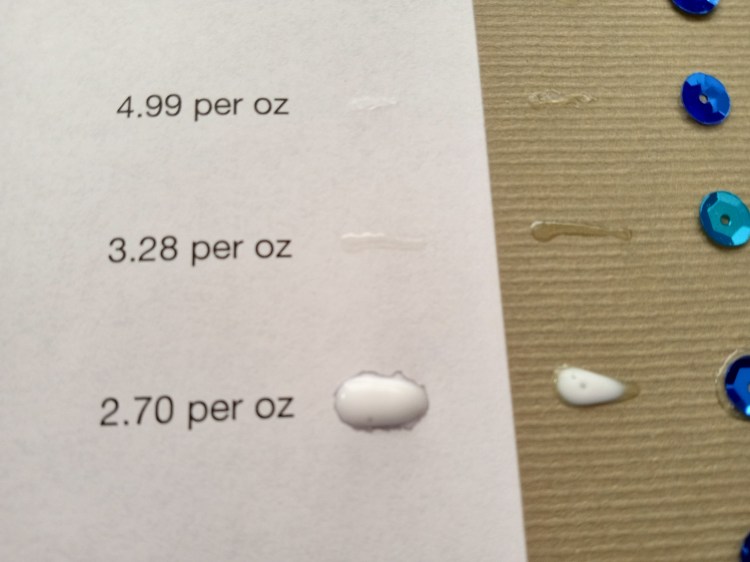
I rejected the Reptile glue as too liquid for my purposes.

That dark ring around the glue is water. That just won’t work for me.

The budget option is to convert the large, inexpensive containers into precise delivery containers. The most common options I’ve seen are glue tubes (filled with a syringe) and one-ounce needle-nose bottles. The one-ounce needle-nose bottles are less work to fill in my opinion, so that’s what I’ve elected to use.

While my preference for normal glueing is Elmer’s or Aleene’s in a mini-bottle, there are some special uses for a couple of these glues.

  • Tombow Mono Multi remains tacky when dry. This can be useful for sticking unmounted rubber stamps to a block or stamping platform, or adhering a stencil to paper.
  • Ranger Glossy Accents remains shiny when dry. This can be useful for creating shiny elements on your project.
  • Reptile is surprisingly effective at adhering paper to plastic. I don’t know when that will come in handy, but I have not found any other PVA glue that can do that.

The one-ounce bottles are readily available, but the ones I’m using are from Amazon (affiliate link):

https://amzn.to/40dtKM4