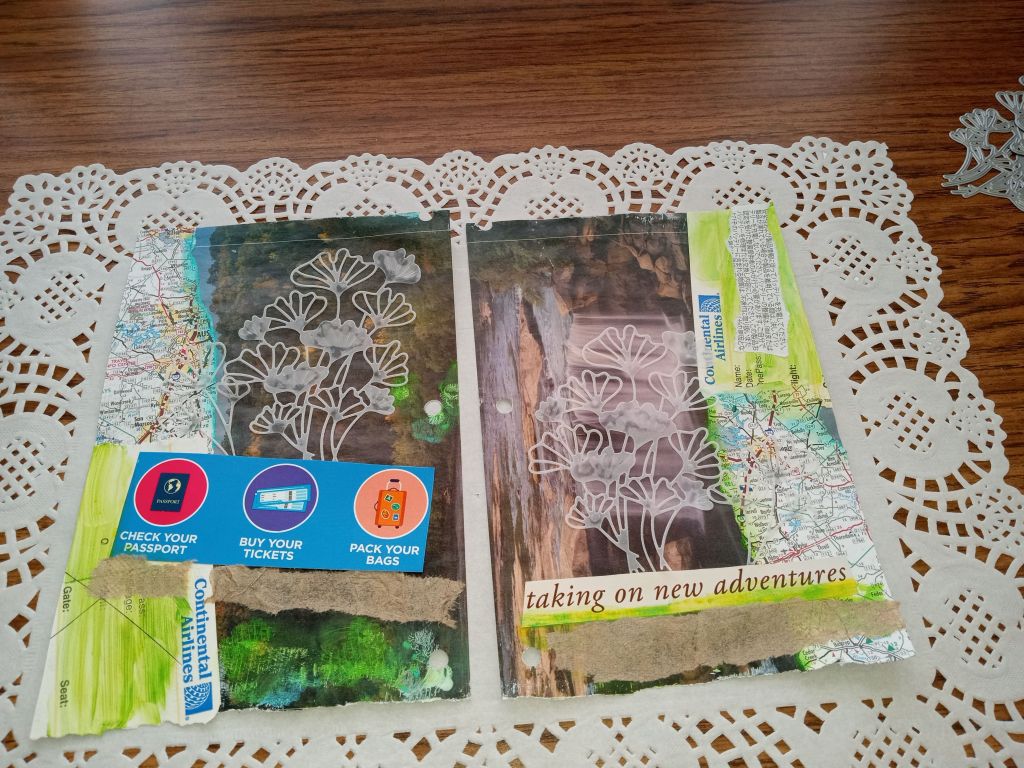
Two junk journal pages for #GetMessyMay prompts, #4 Adventure and #5 Courage. Both with gel crayon, which I’ve really enjoyed using. It’s easily water soluble and blendable!


Two junk journal pages for #GetMessyMay prompts, #4 Adventure and #5 Courage. Both with gel crayon, which I’ve really enjoyed using. It’s easily water soluble and blendable!
Have you ever compared the price of a women’s disposable razor to the price of the same thing sold for men? Or been part of planning a wedding? If so you are aware that prices can vary widely based on who is buying the product. The rule of thumb is that the larger the market, the smaller the price.
When we apply that principle to craft tools we can find some bargains.
In the kitchen section
In the office section
In the makeup section
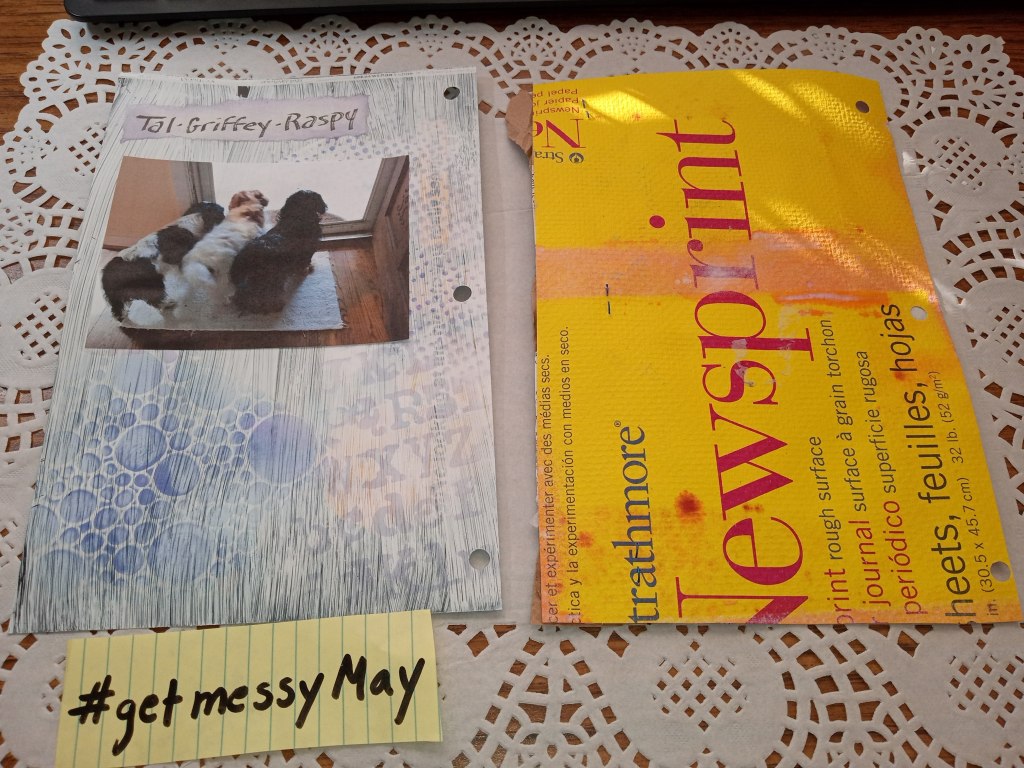
My entrance to papercrafting was traditional scrapbooking back in the early ’90s, so I’m taking a scrapbook approach to this month’s journal. For prompt #2, showing up, I chose a vintage pic of my three dogs waiting at the front door for a visitor to show up.

The left side is a magazine cover, with gesso and stenciling, and the right is the paper from the bottom of my splat box.

Might as well use some of that overspray! Tomorrow’s prompt is “happy.”
I’m going to participate in the journal challenge #getmessymay. The prompts are
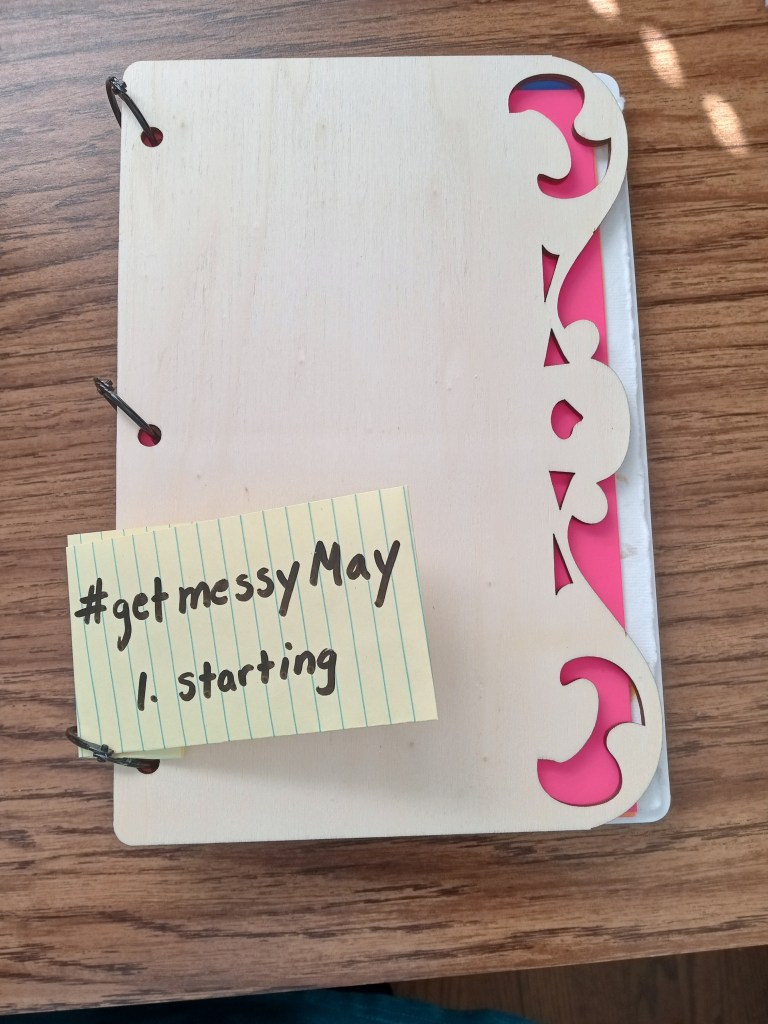
And for prompt #1 starting I choose to put together a junk journal from a Pink Paislee wood album that was a cross-promotion with Tattered Angels, something that’s been in my crafty stash so long it pre-dates the acquisition of Pink Paislee by American Crafts in 2013. It’s part of my challenge to myself to use what I have and not shop. For pages, I’m using various colors of copy paper, some magazine pages, and some paper bags. The journal-in-progress:

Short video here: https://youtu.be/3LciYXShq8Y
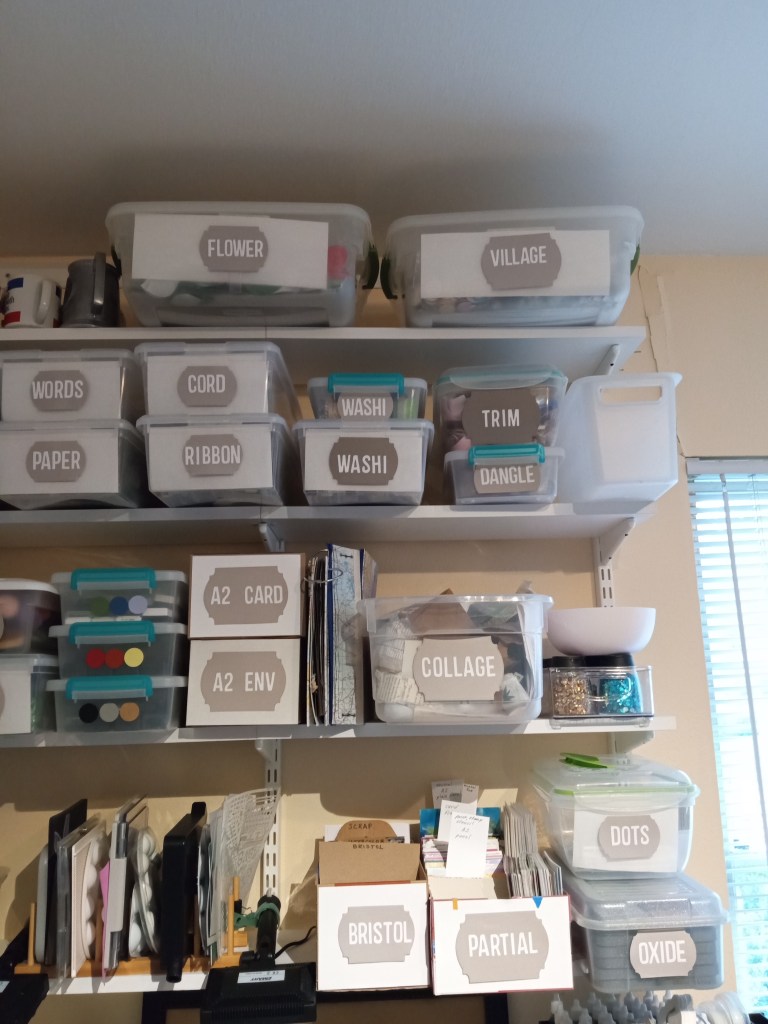
We don’t all have the time or money to install a custom craft space, but you can create a co-ordinated look with your paper craft skills. A consistent label can unify many different types of containers.
You can see in this photo I have fifteen different types of containers. I used whatever I had around the house – mostly shoe boxes in cardboard or plastic, but a couple of smaller containers from the dollar store, and some kitchen organizers.
You can (obviously) create your own labels, but I’m attaching mine in case you’d rather print those than make your own.

You can fussy-cut to keep the shape, or cut in a straight rectangle in the interest of speed. I’ve included a couple of blanks in case your categories don’t match my categories.
Mounted stamps
Traditional red rubber stamps often come mounted (permanently adhered) to a wooden block.
Un-mounted stamps
To save cost and storage space, many new stamps come unmounted. The red rubber or clear photopolymer stamp must be temporarily mounted in order to stamp.
Acrylic block
The lowest cost option is an acrylic block. The block will easily pick up the clear photopolymer stamp or the gray cushion on a red rubber stamp.
Stamp Platforms
A stamp platform is an alternative to an acrylic or wooden block that allows repeat stamping in the exact same place. Stamp platforms can be used with red rubber or clear photopolymer stamps.
Stampin Up Stamparatus $50
7” x 7” base, allows material larger than that to hang out on two sides, offers two reversible lids for layer stamping up to four images (discontinued in 2023, may find used)
Misti by My Sweet Petunia $70
6.5” x 8.5”, enclosed so material cannot hang out and must fit within size of device
Memory Misti is 12 x 12, $109
Sizzix Stencil and Stamp Tool $60
8.25” x 11.75”, open on three sides, offers a stencil holder (that gets bad reviews)
Tonic Tim Holtz Stamp Platform Discontinued in USA
Came in 8’ x 8” and 12” x 12”, open on two sides, for about $35. Worth seeking out used or overseas.
Not quite the same:
Altenew stamp wheel – entire top layer comes off, no hinge, has the ability to turn to create a stamped wreath, integral sticky mat $100
Crafter’s Companion – it’s more like an acrylic block with springy legs, not a stamping platform
Fiskar’s Easy Stamp Press – another acrylic block on legs
Also check out localkingrubberstamp.com for Lisa’s tutorial (#45 in the video library) for making your own from a CD case, or follow the link to YouTube:
Details from my analysis of adhesive. All prices in US dollars, and your price may vary based on bulk buying, coupons, shipping, taxes, and so forth. You are paying for the dispenser and the less dispenser you pay for the less expensive the product.
LIQUID GLUE
Lawn Fawndamentals glue tube 11.00 per ounce 0.55 per foot
Gina K Connect 11.00 per ounce 0.55 per foot
Aleene’s Tacky Glue pen 9.40 per ounce 0.47 per foot
Nuvo Smooth Precision glue pen 8.01 per ounce 0.40 per foot
Elmer’s Precision glue pen 4.67 per ounce 0.23 per foot
Nuvo Deluxe Adhesive 4.99 per ounce 0.25 per foot
Ranger Glossy Accents 3.28 per ounce 0.16 per foot
Reptile Premium craft adhesive 2.70 per ounce 0.27 per foot
Reptile in needle nose 1 oz 0.14 per foot
Bearly Art Precision Craft Glue 1.64 per ounce 0.08 per foot
Elmer’s Glue All Extra Strong 0.31 per ounce 0.03 per foot
Elmer’s in needle nose 1 oz 0.02 per foot
Aleene’s Original Tacky Glue 0.31 per ounce 0.03 per foot
Aleene’s in needle nose 1 oz 0.02 per foot
Big bottle, regular tip repackaged into a one-ounce needle-nose bottle is the least costly.
TAPE RUNNERS
Scotch Extra Strength tape runner 0.33 per foot
Tombow Xtreme tape runner 0.28 per foot
Scotch Create tape runner 0.19 per foot
Elmer’s tape runner 0.19 per foot
Duck Easy Stick tape runner 0.19 per foot
3L E-Z strips tape runner 0.15 per foot
AdTech tape runner 0.12 per foot
American Crafts Sticky Thumb 0.11 per foot
Tombow Mono tape runner 0.11 per foot
Sookwang tear tape 0.08 per foot
ATG refill 0.08 per foot
Recollections tape runner 0.07 per foot
Scor-tape tear tape 0.06 per foot
Tear tape with no dispenser is the least costly.
I continued my review of all my adhesives and learned a few things:
There are five types of ink pads:
Prices generally start around $7 per ink pad for a “full size” pad which is generally 2” x 3”. Mini ink pads cost about half and are generally 1” x 1”, but contain roughly 20% as much ink as a full size ink pad. Ink pads can be made of a felt pad with linen cover or made of foam.
Dye ink pads are quick-drying. They can be either water-reactive or non-water-reactive. One common type of traditional, non-water-reactive dye ink pad is Stampin Up. The most common type of water-reactive dye ink is Ranger Distress by Tim Holtz. There are many brands of both types, including Simon Says Stamp, Hero Arts, and Altenew.
Most stamping is done with dye ink, whether water-reactive or not. Dye ink should be used for stamping an image to be colored with alcohol ink markers (e.g. Copic).
Pigment ink pads are slow-drying. Brands include Versafine (by Tsukineko) and Ranger Archival.
Hybrid ink pads have elements of both dye and pigment. They can be water-reactive (like Ranger Distress Oxide by Tim Holtz) or non-water-reactive. There are many brands, although most are non-water-reactive.
Alcohol ink pads are used for non-porous surfaces such as tile or plastic. The most common brand is Staz-On.
Embossing ink is a clear, sticky ink used for tone-on-tone stamping or embossing. The most common brand is Versamark.
Pigment, hybrid, alcohol, or embossing ink should be used for stamping an image to be colored with a water medium (e.g. watercolor paint.) Any sticky, slow-drying ink can be used for embossing, including pigment, hybrid, and embossing ink.
Manual die cut machines are human-powered and offer a platform with rollers. You crank a “sandwich” of cutting plate, die, and paper (or other material to be cut) through the rollers with a handle.
Basic pieces
The standard cutting plates are a hard polycarbonate plastic. They are consumable, so they will need to be replaced periodically. Turn the plates over top to bottom, left to right, with every cut to reduce warping.
The multipurpose platform or adapter raises the cutting plates so you can use thin dies instead of steel rule dies.
You can successfully die cut with the basic pieces.
Optional extras
The standard cutting plates can be swapped for a self-healing plate on the cutting surface. These are available from scrapbook.com or iCrafter or you can cut your own from any self-healing mat.
Extended cutting plates are needed IF you have an extra-long die.
The chrome precision plate and metal shim may be useful for cutting detailed thin dies. You can also add paper or cardstock shims to your sandwich.
A magnetic plate will gently hold thin steel dies in place. You can also use low-tack tape.
The floppy silicone pad and softer (than polycarbonate) impression pad are used together to emboss (rather than cut) from a thin steel die.
A die brush or die pick can be used to eject small pieces of paper from cutting dies.
Dies and Embossing Folders
Steel rule dies are thick and heavy, 4 ounces or more, and cat cut chipboard, cardboard, or multiple layers of cardstock. New dies are quite expensive, generally $40 and up, and the only company still making these is Sizzix.

Thin steel dies are very thin, comparable to a few sheets of cardstock. Generally these should be used to cut a single layer of cardstock. These are widely available from many manufacturers and designers at a wide range of prices. Some thin dies are words or basic shapes, while others are made to cut out a co-ordinating stamped image.

Embossing folders are two pieces of plastic, hinged, that have a positive raised image on one side and a negative debossed image on the other. You put a piece of paper between the two and run it through the die cut machine to emboss the image onto the paper. These are also widely available and inexpensive.